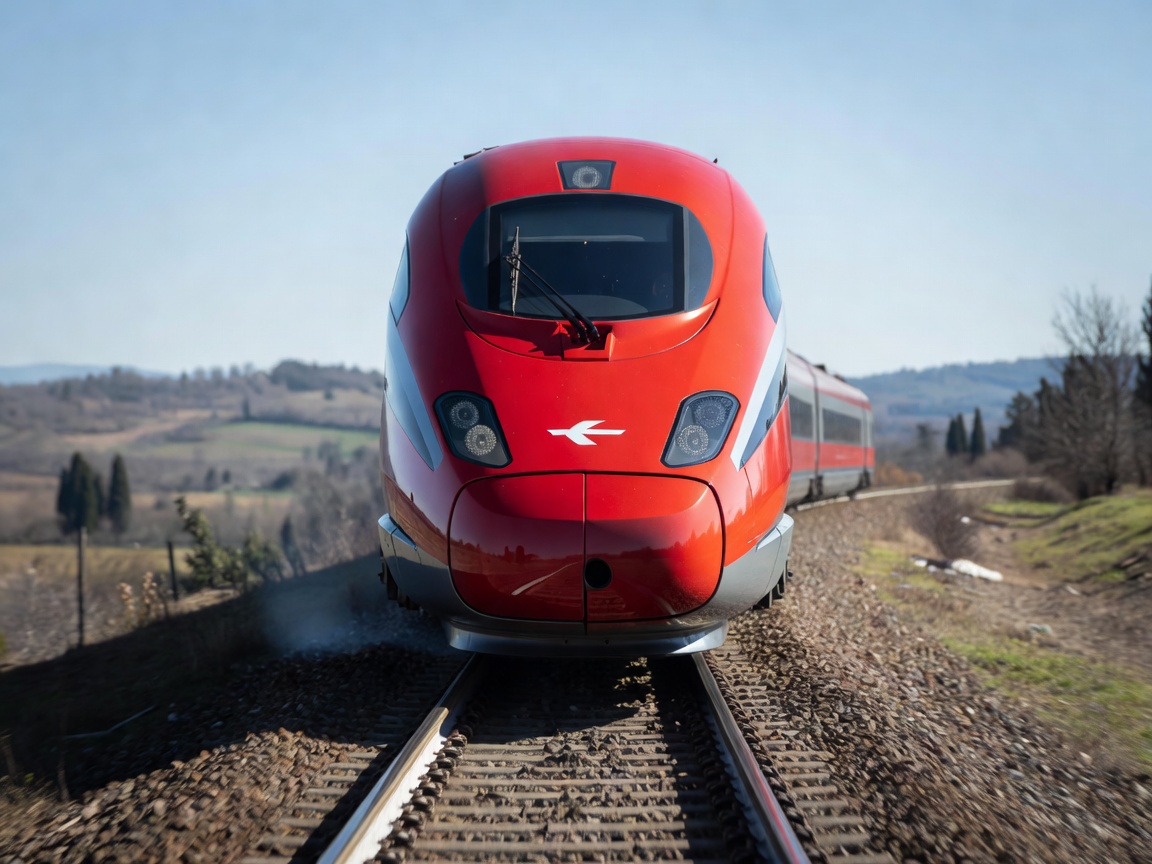
Operated by Trenitalia, the state-owned railway, the Frecciarossa (literally "Red Arrow") is the premier category of high-speed train in Italy. It serves the primary high-speed corridor connecting Turin, Milan, Bologna, Florence, Rome, Naples, and Salerno. The introduction of this network profoundly altered Italian domestic travel, slashing the Milan-Rome journey to under three hours and successfully capturing the majority of market share from domestic airlines on that route.
What makes the Italian high-speed rail landscape unique globally is its competitive open-access market. Frecciarossa operates in direct competition with a private operator, Italo (NTV). This fierce competition has driven down ticket prices while forcing continuous innovation in passenger comfort, onboard services, and train frequencies.
The ETR 1000 (V300 Zefiro)
The crown jewel of the Frecciarossa fleet is the ETR 1000, jointly manufactured by Hitachi Rail Italy and Alstom. Entering service in 2015, this model boasts a distributed traction system across its eight cars, allowing rapid acceleration out of stations. It is technically capable of commercial speeds up to 360 km/h, though current infrastructure limits cap daily operations at 300 km/h.
The aesthetics of the ETR 1000 are not merely incidental. The train’s exterior and interior were styled in part by the legendary design house Pininfarina. The aerodynamic profile drastically cuts crosswind sensitivity, while the interior is noted for its acoustic insulation, utilizing advanced active suspension systems to minimize lateral vibration as the train negotiates the mountainous curves of the Italian peninsula.
Passenger Experience and Class Stratification
Driven by market competition, Trenitalia subdivided the Frecciarossa cabins into four distinct classes: Standard, Premium, Business, and Executive. The Executive class represents one of the most luxurious scheduled rail services in Europe, featuring single leather armchairs, a dedicated meeting room, and at-seat multi-course dining service.
Pros, Cons, and Comparisons
| Feature | The Frecciarossa Advantage | Trade-offs |
|---|---|---|
| Aesthetics & Comfort | Exceptional interior design, superior food and beverage service, low cabin noise. | Premium classes command a steep price premium compared to standard European rail tariffs. |
| Competition | Open market ensures high frequencies and aggressive pricing for advance bookings. | Congestion at major terminus nodes (like Milano Centrale) during peak hours. |
| European Integration | ETR 1000 sets are multi-voltage capable, expanding services into France and Spain. | Cross-border operations still face bureaucratic and signaling incompatibilities across the EU. |
Future Outlook
Trenitalia has aggressively pursued international expansion, deploying Frecciarossa trainsets on the Paris-Lyon-Milan route to challenge the French TGV on its home turf, and operating services in Spain under the iryo brand. The ongoing strategy relies on leveraging the ETR 1000's multi-system interoperability (ability to seamlessly switch between different European electrical and signaling standards) to create a truly pan-European high-speed network that bypasses traditional national borders.