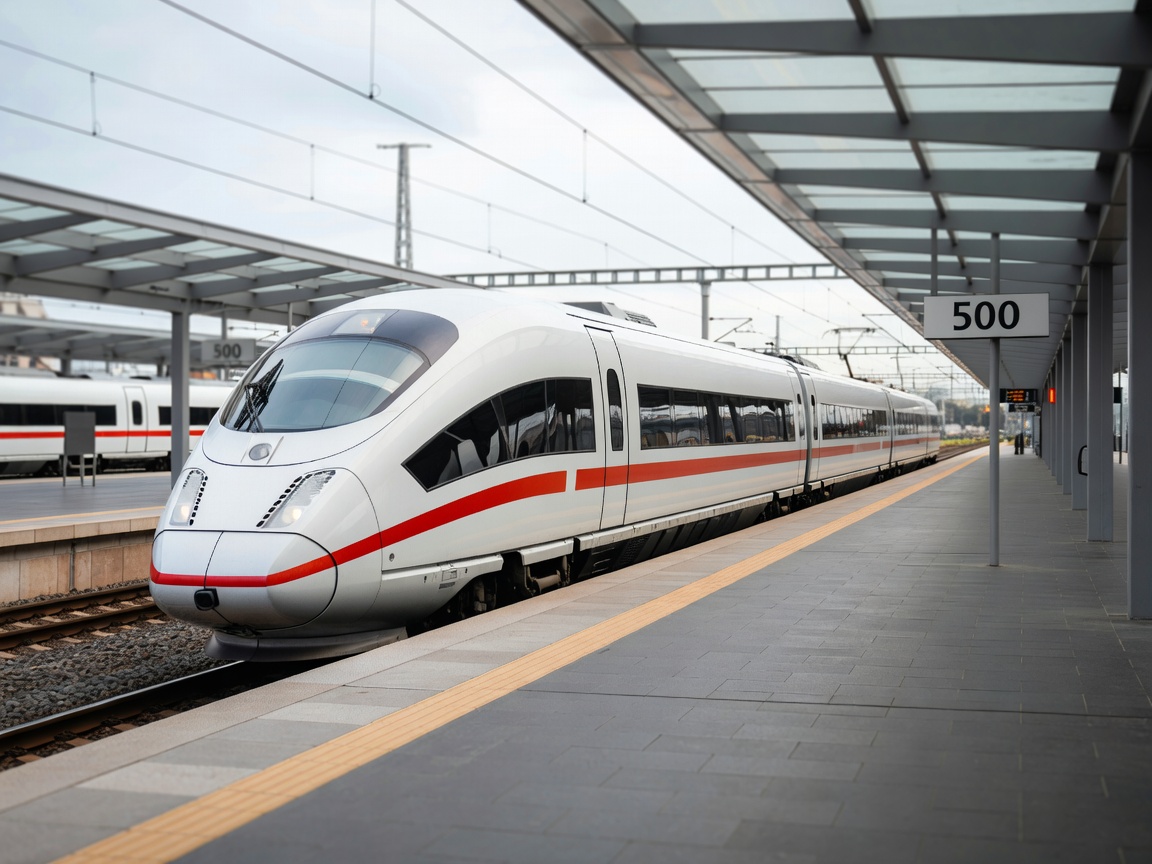
Operated by Deutsche Bahn (DB), the Intercity Express (ICE) is the pinnacle of rail travel in Germany. Unlike the hub-and-spoke geography of France that centers heavily on Paris, Germany features a highly decentralized population spread across multiple major economic hubs—Frankfurt, Munich, Berlin, Hamburg, and the Rhine-Ruhr region. Consequently, the ICE network was not designed as a series of isolated super-corridors, but as an integrated upgrade to the entire national network.
ICE trains utilize dedicated high-speed tracks (Neubaustrecken) capable of 300 km/h where geographically and economically viable, but spend significant portions of their journeys on upgraded legacy tracks (Ausbaustrecken) shared with regional passenger services and freight. This philosophy sacrifices absolute average speed in favor of incredible nationwide reach.
From ICE 1 to ICE 4
The evolution of ICE rolling stock mirrors shifts in rail engineering philosophy. The original ICE 1 and ICE 2 utilized heavy power cars at the ends of the train, similar to the French TGV. However, the introduction of the ICE 3 in 2000 marked a transition to distributed traction (electric motors placed under the passenger cars across the length of the train). This allowed for steeper gradients—up to 4% on the Cologne-Frankfurt line—and provided passengers in the end cars with a unique "lounge" view directly through a glass partition into the driver’s cabin.
The latest iteration, the ICE 4, intentionally scales back the top speed to 250-265 km/h. Deutsche Bahn realized that on a dense, mixed-use network, reliability, passenger capacity, and energy efficiency are more critical than absolute top speed. The ICE 4 focuses on modularity, allowing trainsets to be easily expanded from 7 to 13 cars depending on route demand.
Pros, Cons, and Comparisons
| Feature | The ICE Advantage | Trade-offs |
|---|---|---|
| Network Reach | Serves almost every major and mid-sized city in Germany via mixed-use tracks. | Sharing tracks with freight and regional rail leads to cascading delays; punctuality is a recurring issue. |
| Comfort | Renowned for spacious interiors, generous legroom, and excellent dining cars (Bordbistro). | Complex booking systems and frequent seat reservation errors compared to mandatory-reservation systems like TGV. |
| Engineering | Distributed traction (ICE 3/4) tackles steep gradients effectively. | Lower average speeds compared to fully segregated networks like the Shinkansen. |
Future Outlook
The pressing challenge for the ICE network is infrastructure capacity. Germany’s central position in Europe makes it a transit bottleneck. Deutsche Bahn's "Deutschlandtakt" initiative aims to reorganize the entire national timetable, coordinating high-speed, regional, and freight traffic into a synchronized, pulsing schedule by the 2030s. This requires significant infrastructure investment to eliminate bottlenecks, specifically the construction of new bypasses and the expansion of heavily congested nodes like Frankfurt and Cologne.