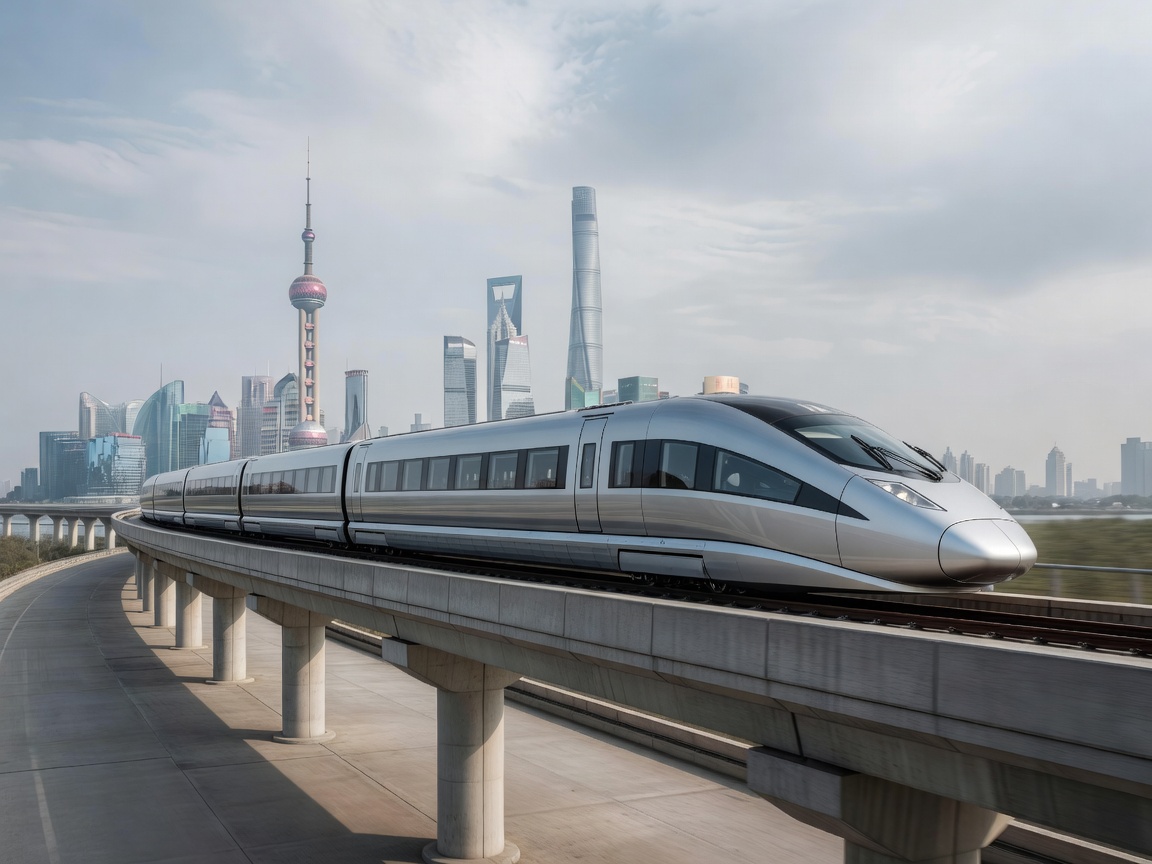
The Shanghai Maglev Train represents a radical departure from two centuries of rail tradition. Rather than relying on the adhesion of steel wheels on steel rails, it operates on the principle of magnetic levitation. Developed in collaboration with German engineering consortiums (Siemens and ThyssenKrupp) using Transrapid technology, the line connects Shanghai Pudong International Airport to Longyang Road Station.
Covering a distance of 30.5 kilometers in just 7 minutes and 20 seconds, the Maglev reaches an astonishing commercial speed of 431 km/h. At this velocity, the primary obstacle is no longer mechanical friction, but aerodynamic drag. The experience of riding the Maglev feels closer to low-altitude aviation than traditional rail transit.
Electromagnetic Suspension (EMS)
The technology driving the Shanghai line is Electromagnetic Suspension (EMS). Unlike standard trains, the undercarriage of a Transrapid Maglev wraps around the edges of a T-shaped concrete guideway. Electromagnets on the train pull upward toward ferromagnetic stators on the underside of the guideway, levitating the train by approximately 15 millimeters.
Propulsion is achieved through a linear synchronous motor. In a conventional electric motor, a rotor spins inside a stator to turn an axle. In a linear motor, the stator is "unrolled" and laid flat along the guideway. By alternating the magnetic fields along the track, the train is pulled forward. This means the engine is essentially built into the infrastructure itself, rendering the train a lightweight, passive vehicle containing only the levitation magnets and cabin electronics.
Pros, Cons, and Comparisons
| Feature | The Maglev Advantage | Trade-offs |
|---|---|---|
| Speed & Gradients | Unmatched commercial speeds; can climb steep 10% gradients without losing traction. | Astoundingly high infrastructure costs per kilometer compared to conventional high-speed rail. |
| Maintenance | Zero mechanical friction between train and track drastically reduces wear and tear. | Highly sensitive guideway tolerances require massive concrete foundations to prevent settling. |
| Interoperability | Completely derailment-proof due to the wraparound guideway design. | Zero compatibility with standard railways; passengers must transfer to conventional trains or subways to reach city centers. |
Future Outlook
While the Shanghai Maglev proved the technical viability of EMS, its lack of interoperability and exorbitant construction costs have hindered global adoption of Transrapid technology. Standard high-speed rail (like China's massive CRH network) proved far more economically scalable. However, the dream of Maglev is far from dead. Japan's under-construction Chuo Shinkansen relies on a different technology (Electrodynamic Suspension using superconducting magnets) and aims to push speeds above 500 km/h over much longer distances, potentially reigniting global interest in levitation transit for the mid-21st century.