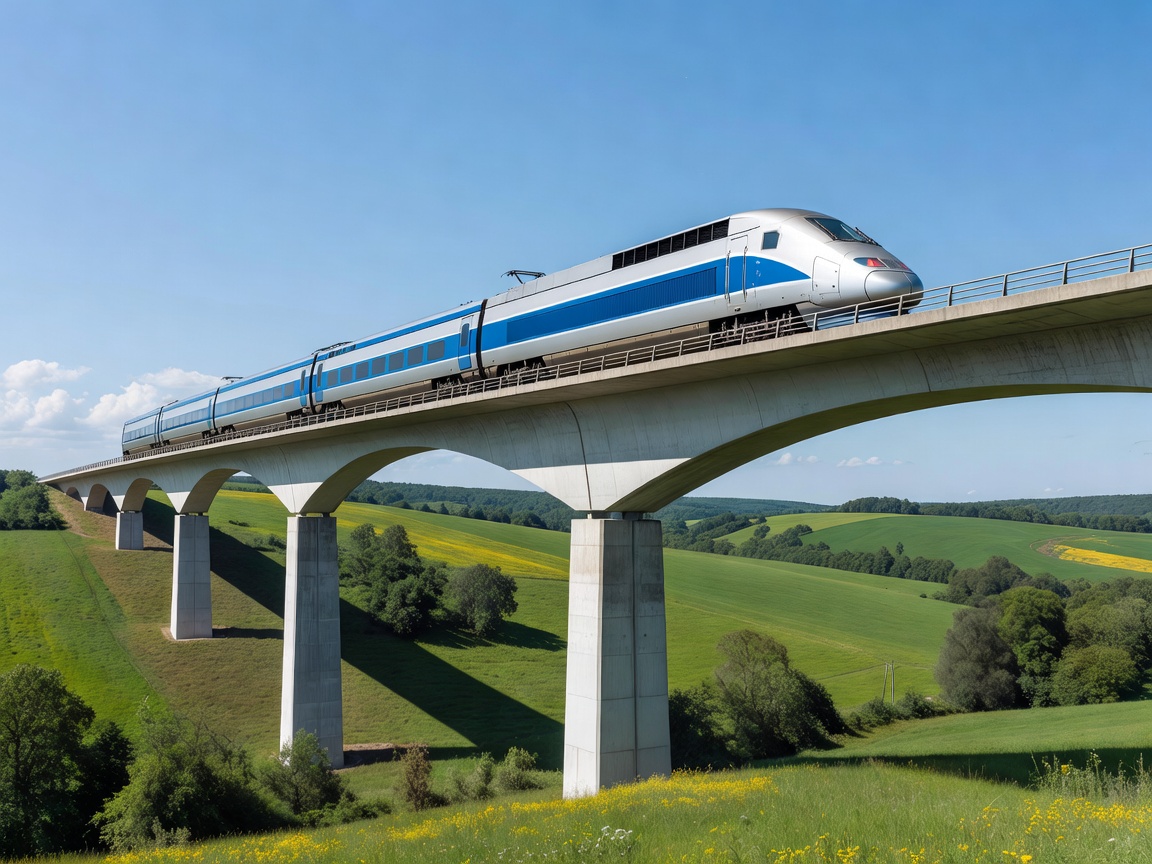
Conceived in the 1970s and launched between Paris and Lyon in 1981, the TGV (Train à Grande Vitesse) is Europe's answer to the Japanese Shinkansen. Initially explored as gas-turbine powered hovertrains, the oil crisis of 1973 pivoted the project permanently toward overhead electric traction. This shift established the technical foundation that would dominate European railways for the next fifty years.
What differentiates the TGV from its Japanese counterpart is its approach to integration. While the Shinkansen operates on a completely isolated track gauge, the TGV runs on the same standard gauge as the rest of the French rail network. TGV trains use specially constructed high-speed lines (Lignes à Grande Vitesse, or LGV) for the bulk of their journey, but smoothly transition to classic railway lines at lower speeds to reach stations in the heart of cities.
Articulated Bogie Design
The mechanical signature of the TGV is its articulated bogie arrangement. In a conventional train, each passenger car sits on its own pair of bogies (wheel assemblies), meaning the ends of two coupled cars have two bogies between them. In the TGV, adjacent passenger cars share a single bogie placed precisely underneath their connection point.
This design yields multiple advantages. First, it lowers the center of gravity, significantly improving stability at speeds over 300 km/h. Second, it reduces the overall number of axles on the train, which lowers maintenance costs and acoustic noise. Finally, in the rare event of a derailment, the articulated connection prevents cars from "jackknifing" or telescoping into one another, keeping the train upright and intact.
The V150 Speed Record
The TGV holds the world record for the fastest conventional wheeled train. On April 3, 2007, a highly modified trainset (named V150, aiming for 150 meters per second) reached a staggering 574.8 km/h (357.2 mph) on the LGV Est line. While this was a testing demonstration rather than commercial operation, it proved the massive tolerance and safety overhead built into the track geometry and overhead catenary systems.
Pros, Cons, and Comparisons
| Feature | The TGV Advantage | Trade-offs |
|---|---|---|
| Network Integration | Seamlessly transitions from high-speed LGV lines to legacy urban tracks. | Susceptible to delays when traveling on shared, legacy portions of the network. |
| Traction System | Concentrated power cars at the front and rear, allowing for quiet passenger cabins. | Heavier axle loads at the ends of the train compared to distributed traction (like the ICE or Shinkansen). |
| Capacity | Extensive use of TGV Duplex (double-decker) sets maximizes passenger capacity per slot. | Slightly reduced luggage space per passenger; steep internal stairs. |
Future Outlook
The TGV platform is currently transitioning to the "TGV M" (Avelia Horizon), scheduled for widespread deployment in the late 2020s. This next generation focuses less on increasing maximum speed and more on modularity, energy efficiency, and passenger density. By returning power modules to a more compact footprint and optimizing aerodynamics, the TGV M aims to cut energy consumption by 20% while increasing total seating capacity, maintaining France's position as a leader in sustainable long-haul transit.