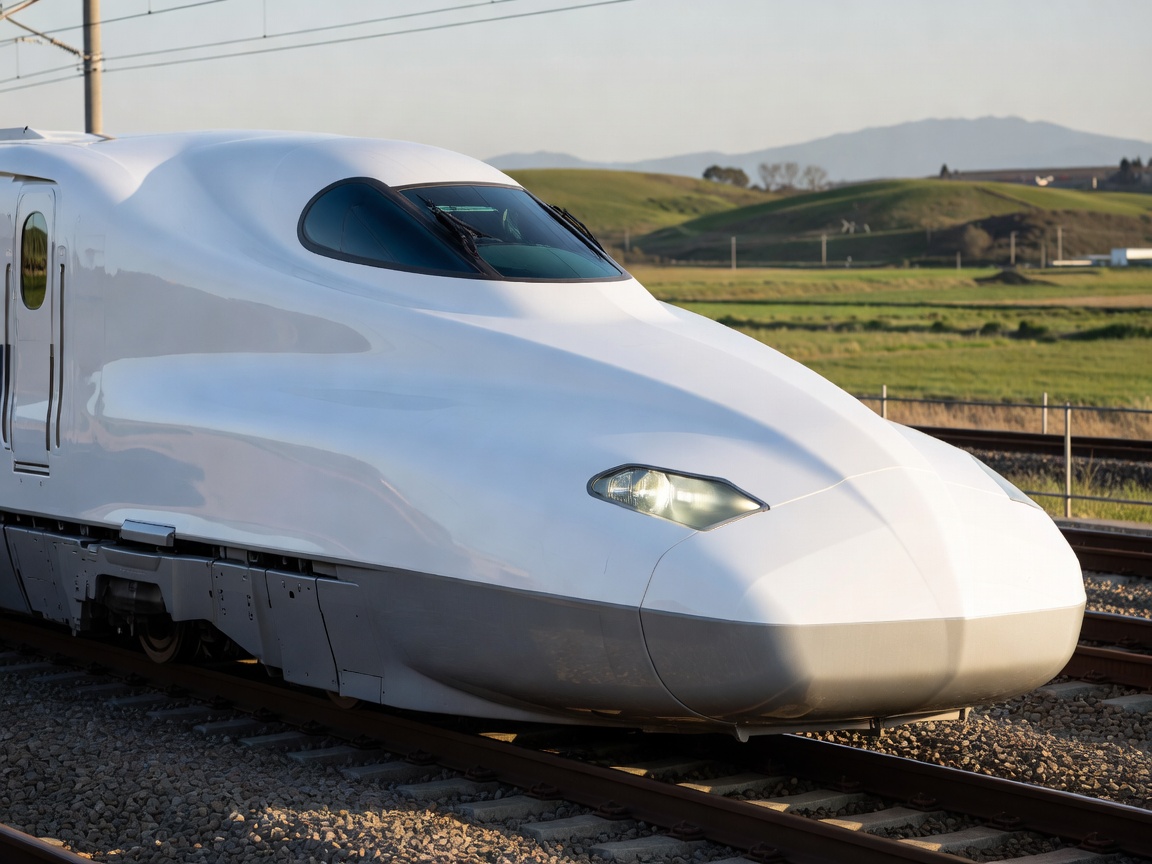
The Shinkansen (新幹線, literally "new trunk line") is broadly regarded as the progenitor of modern high-speed rail. When the Tokaido Shinkansen line opened in 1964 connecting Tokyo and Osaka, it operated at speeds up to 210 km/h. This feat was accomplished not merely through powerful rolling stock, but through the realization that standard tracks, with their sharp curves and level crossings, were inadequate for high-speed operation. Japan’s engineers built an entirely dedicated, standard-gauge network, physically separate from the existing narrow-gauge domestic rail system.
This commitment to segregation is the secret behind the Shinkansen's legendary punctuality and safety. Over nearly six decades of continuous operation carrying billions of passengers, the Shinkansen network has suffered zero passenger fatalities due to derailments or collisions. This immaculate safety record is bolstered by automated train control (ATC) systems that continuously monitor speed and spacing, stripping the reliance on trackside signals which become unreadable at high velocities.
Engineering & Specifications
Modern Shinkansen trains, such as the N700S series introduced in 2020, employ a distributed traction system. Rather than having heavy locomotives at the front and rear, electric motors are distributed along the axles of passenger cars. This design reduces the maximum axle load, resulting in less track wear and significantly improved acceleration and braking profiles. It also maximizes passenger space.
Perhaps the most distinctive visual feature of a modern Shinkansen is its elongated, duck-bill shaped nose. This is not purely for drag reduction, but specifically to address "tunnel boom." When a blunt object enters a tight tunnel at high speed, it pushes a column of air ahead of it, resulting in a loud sonic boom at the tunnel exit. The aerodynamic nose gently parts the air, minimizing micro-pressure waves to comply with Japan’s strict environmental noise regulations.
Seismic Safety Measures
Operating in one of the most seismically active regions on Earth necessitates rigorous safeguards. The system employs the Earthquake Early Warning system (UrEDAS), which detects the primary (P) waves of an earthquake before the destructive secondary (S) waves arrive. If an earthquake over a certain magnitude is detected, power to the overhead lines is immediately cut, and the emergency brakes on all trains in the affected sector engage automatically. During the 2011 Tohoku earthquake, all 27 Shinkansen trains operating in the area stopped safely without a single derailment.
Pros, Cons, and Comparisons
| Feature | The Shinkansen Advantage | Trade-offs |
|---|---|---|
| Infrastructure | Dedicated standard-gauge tracks completely segregated from conventional traffic. | Enormous construction costs; cannot utilize existing narrow-gauge networks for the "last mile". |
| Punctuality | Average delay measured in seconds, largely due to lack of interference from freight or local transit. | System rigidity; disruptions to the main line require massive logistical rerouting. |
| Passenger Experience | Exceptionally quiet interiors, rapid boarding processes, seats can be rotated to face travel direction. | Relatively conservative onboard amenities compared to European counterparts (e.g., fewer dining cars). |
Future Outlook
The standard wheel-on-rail Shinkansen lines are approaching the limits of physical wheel adhesion and environmental noise thresholds. While incremental improvements in the N700S series increase efficiency via silicon carbide semiconductors and battery self-propulsion systems for emergency bridge clearance, the next massive leap for Japanese rail is the Chuo Shinkansen. This is a separate, superconducting maglev line currently under construction between Tokyo and Nagoya, designed to operate at 505 km/h, shifting the paradigm of long-distance domestic travel yet again.